- 07/08/2026
- in Carpet Care Guides, Carpet Cleaning Tips
- by Hobbs Cleaning Ltd
- 102
- 0
Blog

The real question is not simply whether the machine can spray and extract water. Mattress construction, care instructions, foam layers, fillings, adhesives, springs, stains, cleaning chemistry, moisture recovery and ventilation all matter. This guide explains the risks and safer options so you can decide whether DIY wet cleaning is sensible or whether professional mattress cleaning is the better route.
You can sometimes use a carpet cleaner on a mattress if the mattress manufacturer allows wet cleaning and the machine has a suitable upholstery extraction attachment. A large floor head designed for carpets is not the right tool for a mattress surface. It can apply too much moisture, be difficult to control and leave the deeper layers damp.
A mattress is not the same as fitted carpet. Carpet is usually open to airflow from above, can be extracted in repeated controlled passes and normally sits on an underlay or floor that behaves differently from mattress fillings. A mattress can hold moisture below the surface, especially where foam, fibre pads or stitched layers slow evaporation.
Before using any carpet cleaner for mattress cleaning, check both sets of instructions: the mattress care guidance and the machine guidance. If either one says not to wet clean, not to use detergents, not to use heat or not to use the tool on mattresses, follow that instruction.
The mattress care label or manufacturer guidance should always come first. A mattress may say spot clean only, do not wet clean, do not use solvents, do not saturate, do not apply heat or use only a removable washable cover. Some covers can be washed separately, while the mattress core itself should not be wet cleaned.
If the mattress has a removable cover, check whether the cover can be machine washed and whether the inner mattress can be cleaned at all. Washing a removable cover is very different from pushing water into the mattress layers with a wet extraction machine.
No care label does not automatically mean wet extraction is safe. Older mattresses, second-hand mattresses and mattresses with missing labels need extra caution because the surface fabric and inner construction may be unknown.
The main risk is overwetting. A carpet-cleaning machine can apply more liquid than a mattress can safely release, especially if the operator uses repeated wet passes or presses the tool into one area for too long. If moisture travels into foam, padding or inner materials, the surface may feel acceptable while deeper layers stay damp.
Slow drying can lead to musty smells, water marks, residue, reappearing odours and a possible mould or mildew risk if moisture remains trapped. That does not mean every mattress-cleaning attempt will cause a serious problem, but it does mean moisture control is the part DIY users often underestimate.
Unsuitable detergent is another risk. Too much product can leave sticky residue that attracts soil or leaves a chemical smell. Strong household cleaners, laundry detergent, washing-up liquid and random mixtures can be difficult to rinse from a mattress and may affect fabric, dyes or fillings. For product-selection detail, read Hobbs’ guide to choosing a suitable carpet cleaner solution.

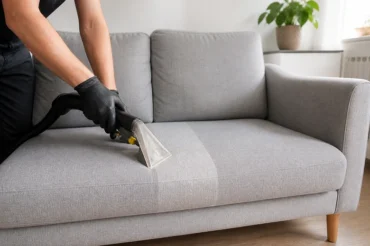
An upholstery tool is usually a smaller hand attachment that sprays and extracts across a narrower fabric area. It gives more control than a carpet floor head and is the only type of carpet-cleaning-machine tool that should even be considered for mattress fabric.
That said, using a carpet cleaner upholstery attachment does not automatically make the job safe. The machine may still apply too much water, the detergent may be unsuitable and the mattress may still be marked as spot clean only. Use the lowest practical moisture, avoid soaking, keep passes controlled and stop if the mattress begins to feel wet beyond the surface.
If your machine has no upholstery extraction tool, do not improvise with the main carpet head. It is designed for a flat floor surface, not a layered mattress that needs careful moisture recovery.
Do not assume a Rug Doctor or any rented carpet-cleaning machine is suitable for your mattress. Check the current instructions for the exact machine, the upholstery or hand-tool instructions, the cleaning product label and the mattress care guidance before starting.
Rental machines can be useful for some carpet jobs, but a mattress needs tighter moisture control and careful drying. If you are comparing rental equipment, Hobbs has separate guides on carpet cleaner rental costs and Rug Doctor carpet-cleaning results and troubleshooting. Those guides explain rental-machine considerations, extraction problems and common carpet-cleaning issues in more detail.
You should be careful with the phrase shampoo a mattress because it can mean very different things. Applying a lot of foamy detergent by hand is not the same as controlled extraction cleaning. The more product you add, the harder it may be to remove residue from the mattress surface and inner layers.
Avoid soaking the mattress, using excessive shampoo, adding household washing-up liquid, using laundry detergent, mixing products or masking smells with heavily fragranced cleaners. Do not add extra detergent because a stain looks bad. More product can make the mattress wetter and stickier without improving the result.
If a stain or odour is serious enough that you feel tempted to keep adding product, stop and reassess. The problem may be below the surface rather than on top of it.
Fitted carpet and mattresses dry in different ways. A carpet has a pile, backing and underlay, while a mattress can contain foam, fibre fillings, adhesives, stitched covers, springs and multiple layered materials. Moisture can move below the visible surface and sit where airflow is limited.
This is why a mattress can look clean but still smell damp later. The surface fabric may dry first, while moisture inside the construction continues to evaporate slowly. A wet mattress also cannot be walked around like a damp carpet. It is usually covered with bedding and used for sleep, so replacing sheets too early can trap moisture further.
Good extraction matters more than a heavy wet clean. If the mattress instructions and machine instructions allow wet extraction, make controlled wet passes and then spend time extracting without adding more liquid, following the machine guidance.
There is no responsible universal drying time for a wet-cleaned mattress. Drying depends on how much moisture was applied, how effective the extraction was, the mattress construction, room temperature, humidity, ventilation, airflow, stain treatment and mattress thickness.
A thin, lightly cleaned surface in a warm, well-ventilated room may dry much faster than a thick mattress that has been heavily wetted. A mattress that feels dry on the top may still hold moisture below the cover, so judge drying carefully and avoid rushing bedding back on.
For details on the professional service and what to expect, see Hobbs Cleaning Ltd’s mattress cleaning service.
No. Do not sleep on a wet-cleaned mattress before it is fully dry. Bedding, mattress protectors and body heat can trap moisture against the fabric and make odours worse.
Keep the mattress uncovered while drying, improve ventilation and use gentle airflow where appropriate. Do not use unsafe heat or place heaters too close to fabric. If the mattress remains damp, smells musty or feels wet below the surface, stop using it until the issue has been assessed.
Urine, blood, vomit and other bodily fluids can be more complicated than ordinary surface soil because liquid contamination can travel below the visible fabric. A carpet cleaner may improve the surface appearance, but it may not reach or fully remove contamination from deeper layers.
For pet urine on carpets, Hobbs has a dedicated guide to dog urine stains and smells, and another guide for cat urine in carpet. For blood, read the guide on how to get blood out of carpet. Those are carpet-focused articles, but they explain why bodily-fluid stains need caution and why chemical recipes are not a good idea.
For mattresses, avoid flooding, bleach mixtures, ammonia mixtures, disinfectant experiments and repeated wet treatment. If contamination is significant, old, unknown or associated with illness, seek appropriate professional or specialist advice rather than trying to force a DIY result.
A carpet cleaner may improve some mattress marks if the mattress is suitable for wet extraction and the stain is mainly on the surface. It cannot guarantee complete stain removal. Results depend on the stain type, stain age, previous products used, mattress material, contamination depth and whether the stain has changed the fabric permanently.
Old stains are often harder because they may have bonded with the fabric or travelled beyond the top layer. Stronger cleaning is not automatically better. On a mattress, aggressive repeated passes can increase the moisture risk without solving the stain.
The best option depends on the mattress, the reason for cleaning and the drying conditions. The table below keeps the comparison practical rather than assuming one route is always right.
| Factor | DIY Carpet Cleaner | Professional Mattress Cleaning |
|---|---|---|
| Equipment suitability | Depends on the machine and whether it has a suitable hand tool. | Assessed against the mattress and cleaning requirement. |
| Moisture control | User must avoid overwetting and extract carefully. | Process can be adjusted to reduce moisture risk. |
| Cleaning solution | Risk of using too much or the wrong product. | Product choice can be matched to fabric and soil type. |
| Stain assessment | Limited if the stain history is unknown. | More suitable where stains, odours or contamination need inspection. |
| Drying advice | Depends on the user reading instructions and managing airflow. | Drying guidance can be given after seeing the mattress and room. |
| Heavy contamination | Often unsuitable for repeated DIY wet treatment. | A safer option for assessment, though results still cannot be guaranteed. |
Avoid DIY wet mattress cleaning where the risk is higher than the likely benefit. Common stop signs include:
Professional assessment may be more sensible when the mattress is valuable, the fabric is unknown, the stain is old, the odour is strong or the cleaning instructions are unclear. It may also be better where you cannot create suitable drying conditions at home.
Professional cleaning should still be realistic. Complete stain, odour or contamination removal cannot be guaranteed before inspection, especially where liquid may have travelled below the surface.
Hobbs Cleaning Ltd provides professional mattress cleaning across Hemel Hempstead and surrounding areas, including Berkhamsted, Tring, St Albans, Harpenden and Milton Keynes. If DIY wet cleaning is unsuitable for your mattress, professional assessment can help determine a more appropriate cleaning approach.
For booking details, see Hobbs Cleaning Ltd’s mattress cleaning service. For current charges, view the Hobbs prices page. If you are unsure whether your mattress is suitable for wet cleaning, contact Hobbs Cleaning Ltd with details before attempting a DIY clean.
Unsure Whether Your Mattress Can Be Wet Cleaned?
If the care label is unclear, the mattress smells damp or a stain may have travelled below the surface, ask Hobbs Cleaning Ltd for advice before adding more moisture.
View mattress cleaning or request advice from Hobbs Cleaning Ltd.
Sometimes, but only if the mattress instructions and machine instructions allow it, and only with controlled moisture and a suitable upholstery extraction tool. Do not assume every mattress can be safely wet cleaned.
You may be able to use a carpet cleaner on a mattress if it has a proper upholstery attachment and the mattress can tolerate wet extraction. A carpet floor head should not be used on a mattress.
Check the current Rug Doctor machine instructions, hand-tool instructions, cleaning product label and mattress care guidance. Do not rely on the machine name alone.
Avoid heavy shampooing, soaking and excessive detergent. Controlled extraction may be possible on some mattresses, but adding lots of foam or household detergent can create residue and drying problems.
An upholstery attachment is more suitable than a carpet floor head, but it does not make every mattress safe to wet clean. Mattress care instructions and drying conditions still matter.
As little as practical. The aim is controlled surface cleaning with effective extraction, not soaking. If the mattress feels wet beyond the surface, stop adding moisture.
Drying time varies depending on moisture, extraction, mattress construction, room temperature, humidity and airflow. Do not replace bedding or sleep on the mattress until it is properly dry.
Only after it is fully dry. Sleeping on a damp mattress or replacing bedding too soon can trap moisture and worsen odours.
It may improve some surface staining, but urine can travel into deeper layers. Do not flood the mattress or keep adding products if the smell remains.
Yes, unsuitable or excessive solution can leave residue, affect fabric or make drying harder. Follow the mattress and product instructions, and avoid household chemical mixtures.
Using a carpet cleaner on a mattress is a suitability decision, not just a cleaning shortcut. The safest approach is to check the care instructions, use only an appropriate upholstery tool if wet extraction is allowed, control moisture carefully and give the mattress enough time and airflow to dry. If the stain, odour or material risk is beyond a light surface clean, professional advice is usually the better next step.